
- Top Page
- Services
- Marine Consulting
- Green Transformation (GX)
Marine Consulting Green Transformation (GX)
- GX-Related Maritime Consulting: Case Studies and Achievements
- Overview of GX-Related Maritime Consulting
- Project Case Studies
- Future Outlook and Vision
GX-Related Maritime Consulting: Case Studies and Achievements
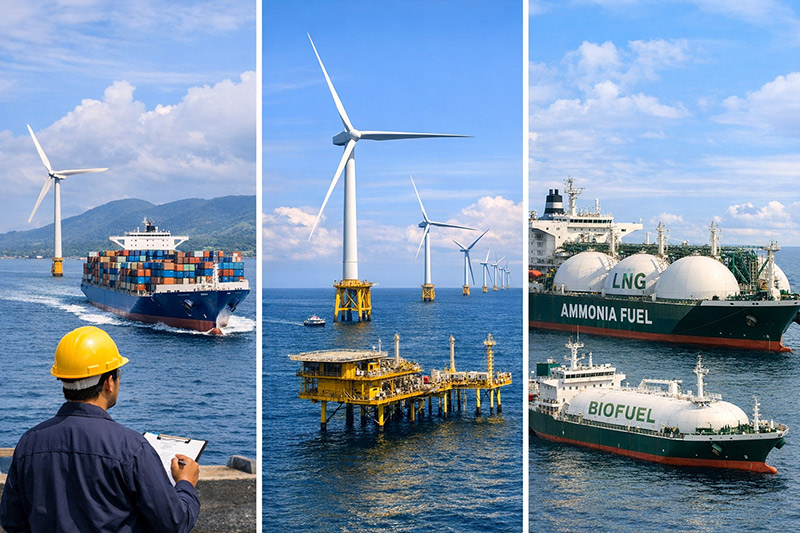
MOL Maritime (Mitsui O.S.K. Lines Maritechs Co., Ltd.) supports decarbonization and sustainable growth in the shipping industry through maritime consulting for GX (Green Transformation).
To date, we have promoted a wide range of projects, including the development of safety measures and guidelines for introducing next-generation fuels such as ammonia, biofuels, and LNG; feasibility studies for offshore wind power projects; and the examination of strategies to address international environmental regulations.
These initiatives help lead regulatory compliance and technological innovation both domestically and internationally, contributing to improved safety and competitiveness across the industry.
Overview of GX-Related Maritime Consulting
GX (Green Transformation) refers to the transformation of industrial structures and energy supply systems aimed at achieving a decarbonized society.
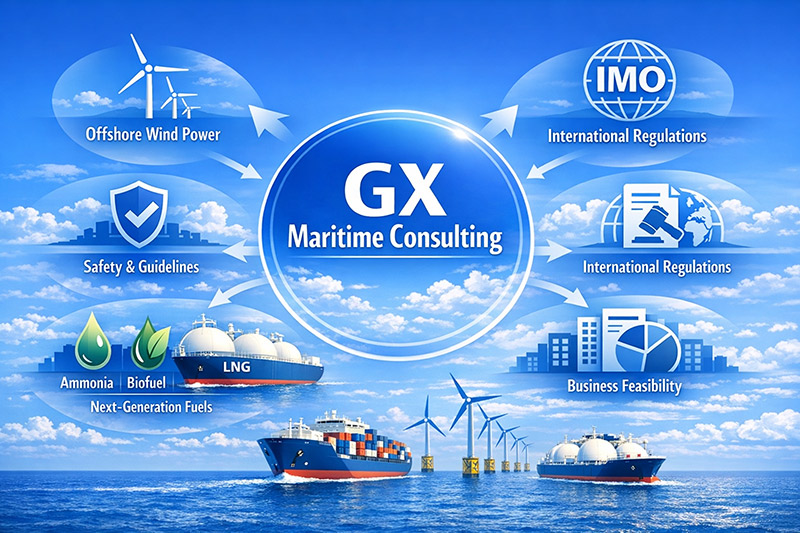
To support the promotion of GX in the maritime sector, we provide consulting services in the following areas:
- Support for the introduction of next-generation fuels (ammonia, biofuels, LNG)
- Feasibility studies for offshore wind power projects
- Development of strategies to address international environmental regulations
- Formulation of safety measures and guidelines
Project Case Studies
| Project Title | Development of navigation safety and accident-prevention measures and guidelines required for implementing ammonia bunkering |
|---|---|
| Client | Maritime Bureau, Ministry of Land, Infrastructure, Transport and Tourism (Marine Environment Policy Division) |
| Objective | To examine the necessary equipment requirements and safety measures, and to develop guidelines to promote an enabling environment for commercial operations, toward the safe and smooth implementation of bunkering (fuel supply) for ammonia-fueled vessels. |
| Scope of Work |
|
| Key Features / Significance | This project establishes a foundation that contributes to the future development of sustainable shipping and the reduction of environmental impacts. By clarifying specific equipment requirements and safety measures for ammonia bunkering and systematically organizing responses to risks anticipated during bunkering, it enhances industry-wide safety and promotes the practical implementation of ammonia-fueled vessels. In addition, developing practical guidelines enables related operators and relevant organizations to carry out operations under unified safety standards, providing field-oriented guidance aligned with real-world practices. |
| Project Title | Study on the use of biofuels in ships |
|---|---|
| Client | Maritime Bureau, Ministry of Land, Infrastructure, Transport and Tourism (Marine Environment Policy Division) |
| Objective | To promote the use of biofuels in ships by examining feasibility from economic and technical perspectives and by developing and revising guidelines, thereby further accelerating the adoption of biofuels in the maritime sector. |
| Scope of Work |
|
| Key Features / Significance | The project provides a multifaceted analysis of the status of biofuel use in the maritime sector. By clarifying the actual conditions such as supply volumes and pricing, it contributes to the future development of sustainable shipping. It also plays an important role by organizing challenges and presenting industry-wide guidance necessary to promote biofuel adoption from the perspective of reducing environmental impacts. |
| Project Title | Organizing safety measures for inspection/repair work on LNG-fueled ships to strengthen the competitiveness of gas-fueled vessels |
|---|---|
| Client | Maritime Bureau, Ministry of Land, Infrastructure, Transport and Tourism (Shipbuilding Industry Division) |
| Objective | To organize safety measures for inspection and repair work on LNG-fueled vessels based on the latest information, thereby supporting the wider adoption of gas-fueled ships, advancing an enabling environment for carbon neutrality in the maritime sector, and strengthening the competitiveness of Japan’s maritime industry. |
| Scope of Work |
|
| Key Features / Significance | A key feature is the systematic organization of safety measures for inspection and repair work on LNG-fueled vessels, contributing to improved on-site safety and greater operational efficiency. |
| Project Title | Business feasibility study on floating offshore wind power facilities and work vessels in foreign countries |
|---|---|
| Client | Maritime Bureau, Ministry of Land, Infrastructure, Transport and Tourism (Shipbuilding Industry Division) |
| Objective | To realize carbon neutrality early as a countermeasure against global warming, this project conducted a detailed study on the feasibility of business development for floating offshore wind power facilities and work vessels in surrounding seas, including Asia, and supported the formation of related projects that Japan’s shipbuilding industry can help promote. |
| Scope of Work |
|
| Key Features / Significance | By analyzing the latest overseas cases and investigating ports suitable for floating construction/assembly and practical approaches using local base ports, the project evaluated feasibility and efficiency in concrete terms. It also clarified issues and potential for domestic adoption through overseas case analysis, providing practical and foundational insights that support future offshore wind development in Japan. |
| Project Title | IMO International Cooperative Response Support Fund Project – Study on the environmental impacts of ammonia fuels |
|---|---|
| Client | Japan Ship Technology Research Association (JSTRA) |
| Objective | To contribute to international discussions at the IMO by scientifically evaluating the impacts of ammonia-fueled ships on the external environment and organizing information that supports establishing safety requirements and improving social acceptance. |
| Scope of Work |
|
| Key Features / Significance | A key feature is the collaboration among industry and administrative bodies under the IMO support-fund framework to address challenges. The project provides an important foundation for realizing sustainable shipping. |
Future Outlook and Vision
- Strengthening responses to international environmental regulations: Further enhance Response to international environmental regulations, including those of the IMO, and actively participate in standards development.
- Promoting the adoption of next-generation fuels: Continue technical verification and the development of safety standards for new fuels such as ammonia, biofuels, and LNG.
- Expanding renewable energy projects: Support business feasibility assessments and supply-chain development in renewable energy sectors, including offshore wind power.
- Strengthening collaboration with industry and government: Reinforce cooperation with government agencies, industry associations, shipbuilders, and shipping companies.
Leveraging GX-related technologies and expertise, we are committed to contributing to solving social challenges as a leading company that helps create a sustainable future for the maritime industry.
Marine Consulting Case Studies


Maritime Consulting
Please feel free to contact us about our Maritime Consulting and associated services.
If you are interested in Option materials about our maritime consulting services including an introduction to evaluation and review methodologies and the process for using services, please feel free to contact us here.